
Understand the Facts About Your Data Health
Knowing the state of your data is the foundation for smarter, faster business decisions that drive revenue and growth.
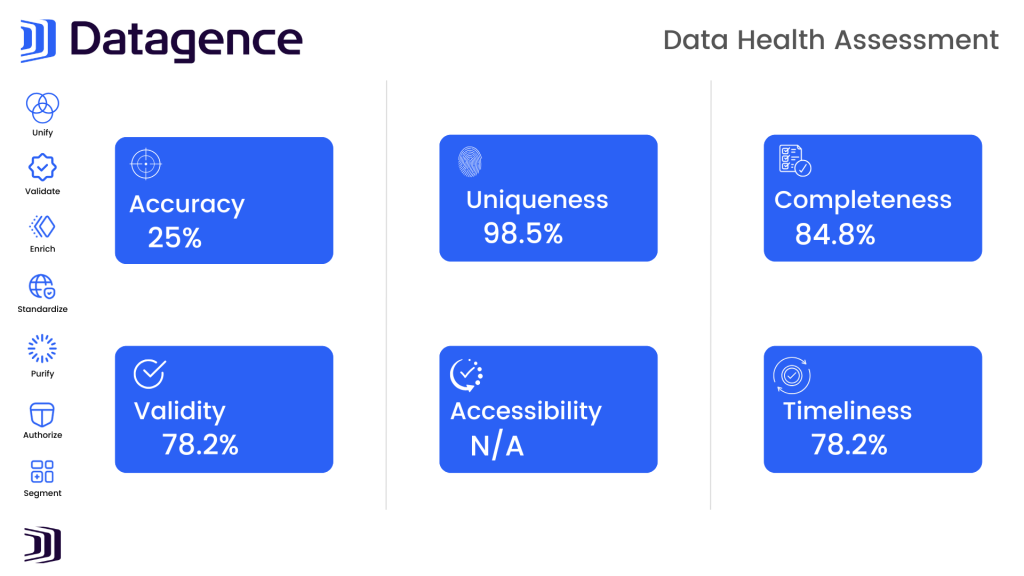
Knowledge is Power
A Data Health Assessment is critical for any business aiming to thrive in today’s data-driven landscape. It provides a clear, actionable snapshot of your data’s quality, reliability, and alignment with your revenue goals—uncovering gaps, inconsistencies, and inefficiencies that could silently undermine your operations.
By pinpointing where your data excels or falls short, you are empowered to enhance decision-making and align teams across your organization. Much like a medical check-up, a data health assessment can help your business avoid costly missteps. Healthy data ensures your organization is confidently turning raw data into a strategic asset that drives measurable growth.
How could your company benefit from knowing exactly where your data stands?
Accuracy
Data Accuracy means your data is correct, truthful, and free of errors. In short, data accuracy means your data matches real life with no mistakes.
Why it matters: Inaccurate data leads to wrong decisions, lost trust, and wasted resources. Imagine the impact of shipping the wrong product, targeting the wrong customer, or misreporting revenue.
Uniqueness
Data Uniqueness refers to the quality or characteristic of a dataset in which each record or data point is distinct and non-repetitive within a defined context or scope.
Why it matters: Duplicate data leads to wasted marketing spend, poor customer experiences, and bad decisions.
Completeness
Data Completeness means your data has all the required information available – nothing missing, nothing half-filled.
Why it matters: incomplete data leads to poor decisions, broken workflows, and missed opportunities. Missing information skews reporting.
Validity
Data Validity means your data is in the right format, follows the right rules, and fits the purpose its mean for.
Why it matters: Even if data is complete and accurate, if it is not in the right format, it’s useless. – if a phone number or data is in the wrong mat, it can block automation.
Accessibility
Data Accessibility means the right people and teams can easily find, retrieve, and use the data they need, when, where, and how they need it.
Why it matters: If data is buried in silos, locked behind permissions, hard to navigate, or simply not available across systems, it slows down teams, hinders and hurts decision-making, leading to duplicate work, frustration, and missed opportunities.
Timeliness
Data Timeliness means your data is up-to-date and available when its needed.
Why it matters: outdated data leads to missed signals, delayed decisions, and irrelevant actions – such as marketing to a customer who has already churned or relying on the wrong numbers from last quarter to make the call for this quarter.
The real cost of bad data
The cost of bad data isn’t just technical. It’s financial, operational, and reputational. A single error can ripple across systems, people, teams, and decisions. A data health assessment is damage control, growth insurance, and operational leverage.
While the actual cost of bad data is dependent on the datasets, business, and industry, research indicates the cost to be significant.
Lost Revenue
Incorrect or Missing Data
- Incorrect or missing data causes customer churn, billing errors, and missed upsell opportunities.
Chasing Bad Leads
- Sales reps chase bad leads instead of focusing on real prospects.
Wasted Spend
Duplicate Contacts
- Duplicate contacts = wasted ad dollars and sales effort.
Incomplete or Invalid Records
- Incomplete or invalid records = bounced emails, failed outreach, and misdirected delivery.
Slower Decisions
Inaccessible or Outdated Data
- Inaccessible or outdated data delays reporting, forecasting, and strategy.
Chasing Data
- Teams spend more time finding data than using it.
Operational Breakdown
Broken Automation
- Invalid data formats break automations, integrations, and reporting systems.
Wrong Workflows Triggered
- Inaccurate data triggers the wrong workflows and blocks key processes entirely.
Damaged Trust
Lost Customer Confidence
- Customers lose confidence when they’re contacted with incorrect info – especially when its repeated.
Leadership Loses Faith
- Leadership loses faith in the numbers, people, and teams – creating friction between departments.
Fix the cracks in your foundation.
Get an overview of the health of your data so you know where to start rebuilding. We can help,